World Brain Day: Why Every Child Learns Better When the Body and Brain Work Together
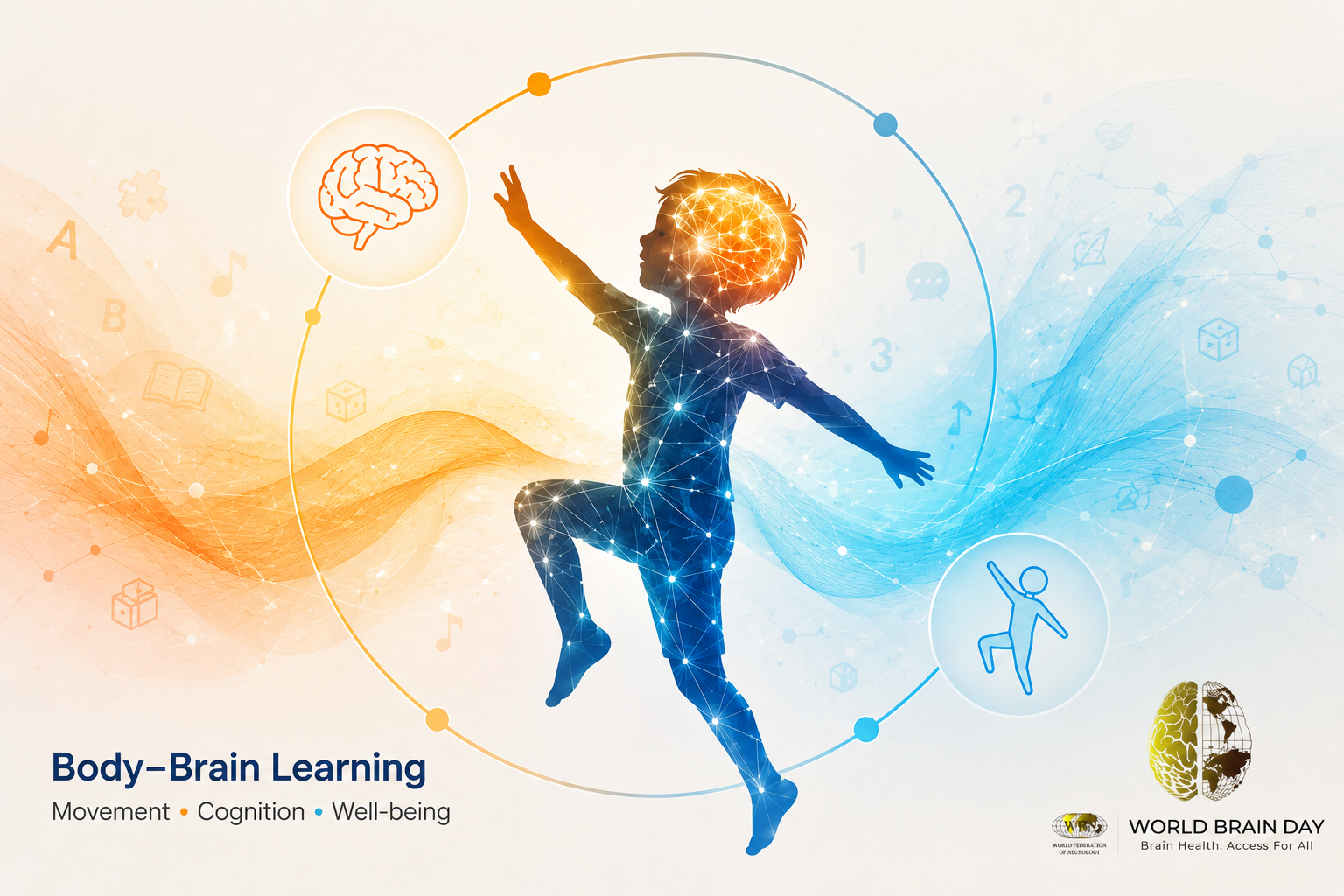 On World Brain Day, we celebrate one of the most remarkable organs of the human body—the brain. Brain development begins long before academic achievement becomes visible. From the preschool years onward, every movement, interaction, and meaningful learning experience contributes to shaping how children think, remember, communicate, and thrive.
Modern neuroscience increasingly supports what educators have intuitively known for generations: children do not learn through the brain alone—they learn through the continuous interaction of the brain, the body, and the environment. This perspective has become one of the cornerstones of contemporary educational research and offers valuable insights into how we can better support children's cognitive, emotional, and social development.
The Body–Brain Connection
The theory of Embodied Cognition suggests that thinking is deeply connected to physical action. Learning is not simply a mental activity that happens while sitting still; it is enriched through movement, sensory experiences, exploration, and interaction with the world. This understanding aligns with the position of the American Academy of Pediatrics, which consistently highlights active play as an essential component of healthy child development. Movement, exploration, and meaningful interaction support not only physical health but also academic, cognitive, social, and emotional growth during the early years.
Growing evidence indicates that integrating purposeful movement into learning can support attention, working memory, executive functions, motivation, and overall learning engagement. When children actively experience concepts through their bodies, learning becomes more meaningful, memorable, and enjoyable.
This body–brain connection is particularly important during the early years of education, when children's cognitive, motor, language, and social skills develop together rather than independently.
Active Learning: Engaging the Whole Child
Active learning places children at the centre of the educational experience. Instead of passively receiving information, learners explore, make decisions, collaborate, solve problems, and physically interact with learning activities.
When thoughtfully designed, digital educational technologies can become powerful facilitators of this process. Motion-based learning environments combine movement with meaningful educational challenges, encouraging children to actively participate rather than simply observe.
By engaging multiple sensory and motor systems simultaneously, these learning experiences create rich opportunities for children to develop cognitive skills while maintaining high levels of curiosity, motivation, and participation.
Well-being Begins with Meaningful Learning Experiences
Brain health is closely connected with children's overall well-being. Positive learning experiences influence not only what children know, but also how they feel about themselves as learners.
Movement-rich learning environments encourage joy, curiosity, confidence, persistence, and active participation. They promote intrinsic motivation by allowing children to learn through exploration and discovery rather than passive instruction.
This whole-child approach recognises that cognitive, physical, emotional, and social development are interconnected—and that nurturing one dimension strengthens the others.
Creating Equal Opportunities for Every Learner
Every child's brain develops differently. This diversity should not be viewed as a challenge to overcome but as a natural characteristic of learning.
Body–brain learning approaches are particularly valuable because they provide multiple pathways for participation. Children with ADHD, autism, learning difficulties, motor challenges, or other special educational needs can engage alongside their peers through experiences that are adaptable, inclusive, and meaningful.
By offering different ways to interact with learning activities, educators can create classrooms where every learner has the opportunity to participate, succeed, collaborate, and build confidence.
Turning Brain Science into Educational Practice
At Kinems, the connection between movement and learning is more than an educational strategy—it is the scientific foundation of our philosophy.
Our active learning experiences are inspired by the growing understanding that children learn best when cognition, movement, play, and social interaction work together. By integrating body movement into meaningful educational activities, we aim to support children's holistic development while helping educators create engaging, inclusive, and motivating learning environments.
This World Brain Day reminds us that every child's brain is unique—and every child deserves learning experiences that allow them to flourish. By embracing the power of the body–brain connection, we can move towards a future where education supports not only academic achievement, but also curiosity, confidence, well-being, and lifelong learning.